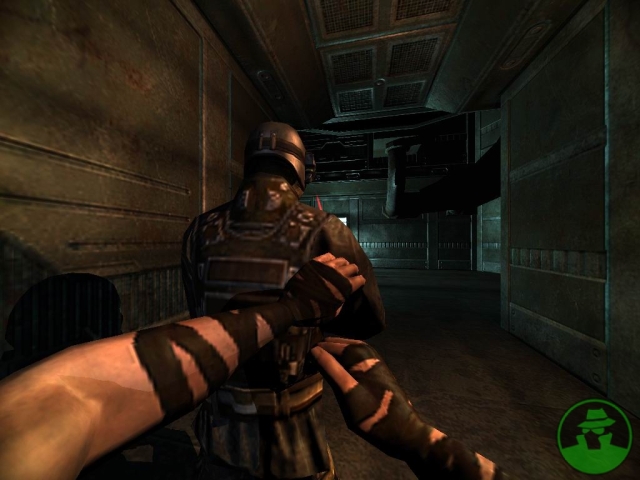
Not too long ago, I played Chronicles of Riddick: Escape from Butcher Bay for the first time. I was really digging its first-person stealth action in theory, but the experience fell apart for me very quickly. I got to a point early on where Riddick had to fight his enemies in a head-on manner and it just did not work out well for me. Even when I lowered the difficulty to easy, I kept getting smoked by the computer. It seemed like when I was forced to defend myself in a non-stealthy way, Riddick was seemingly useless.
I’ll be the first to admit that I’m not good at stealth games. But I think there’s something to be said about the way stealth is implemented in games, particularly when a player has to fight outside the context of stealth.

My three favourite stealth games are Goldeneye 007 on the Nintendo 64, Batman: Arkham Asylum and Batman: Arkham City. In all three of those games, there are times when it is to your benefit to play stealthy, particularly on higher difficulty settings. However, if for whatever reason, you’re in a situation where you have to fight in a more direct manner, you’re equipped to deal with it. For James Bond, he has the health, weapons, armour and gadgets to fight through. For Batman, he has great hand-to-hand combat skills, gadgets, and mobility.
In most stealth games I’ve played, you’re not equipped to deal with these types of scenarios. If that’s how a creator wants to make their game, that’s fine. However, in the case of The Chronicles of Riddick: Escape from Butcher Bay, I was put in a firefight scenario, and didn’t have the tools to deal with the situation. There were a number of enemies; all of which were bullet sponges. Their shots were extremely accurate. Meanwhile, there was no place for Riddick to take cover, and his tolerance for bullets is low.
Though I’m not good at stealth games, I can at least appreciate them when the mechanics all work together into a cohesive experience. I felt like they didn’t in this particular scenario.
 In Third Person