
Going into Elder Scrolls V: Skyrim, I had little to no interest in the series or the type of fiction this game is based on. I was bored by the Lord of the Rings movies, have no interest in playing anything like Dungeons & Dragons, and outside of Fire Emblem, never cared to play any video games based on fantasy. Prior to my brother and I’s purchase of Skyrim, we finally decided to play our copy of Oblivion, which has been sealed and sitting on our shelf for a year. While I could appreciate the ambition behind the game, the start of that game didn’t win me over. The start of that story wasn’t interesting, the race and class system was far too confusing for my tastes and the use of ‘ye olde English’ font irritated me from a readability and overall design perspective.
All things considered, I shouldn’t like Skyrim. The only reason I even bought it in the first place was because I think I’d be missing out on the gaming zeitgeist if I didn’t play this game. However, instead of shrugging it off like Oblivion, Skyrim has won me over in a big way.
Skyrim’s biggest achievement, among the many it has under its belt, is its ability to immerse you into the game world. It does this by giving you a plethora of choices that make the experience feel organic. The quests are structured in a way that you can follow or jump between a number of major and minor story threads at your leisure. Oftentimes within those quests, they’re open-ended in a way that really gives you the power of choice. You can simply stumble upon different things to do just by walking around towns or the woods. When it comes to your inventory, you get a ton of different options for weapons, armour, spells and more. Story points can also be greatly impacted by the dialogue you choose for your character.

While the openness of the game’s structure freaked me out at first, I soon embraced it when I realized how organic it let the experience be. My favourite example of this happened early on, when I was originally on a quest to notify the Jarl of Whiterun of the dragon sighting. As I walked to Whiterun, I ran into a group of Imperial soldiers, who were escorting a Stormcloak rebel somewhere. I followed them for awhile, passing a tower and a fort along the way, until I decided to free the prisoner. I fight broke out because of this and everyone but me died, but I got to steal all of their stuff. On the way back I ransacked the fort, visited the tower, and ran into a horse and carriage in front of Whiterun, offering me a ride to distant places. On a whim, I decided to go to the farthest place on the map where I had an objective, which led me to join the mage college in Winterhold. I would eventually notify the Jarl of Whiterun, but not until I completed a number of other mage related quests, including one where my soul was placed inside a sacred gem to kill the soul of another person stored in that gem.
This entire sequence of events didn’t feel like a video game at all to me. This felt like I was just a person in this world, and those were the choices I made. The quests themselves all felt of a high-quality too, as many of these scenarios were well thought out and are fun to play through. Even though I’m not traditionally a fan of medieval fiction, any of my preconceived prejudices didn’t matter here, as the quality of the fiction was great. This seemingly never-ending tale of medieval awesomeness stayed entertaining throughout. My brother, in contrast, has also been playing Skyrim, and the story he’s created for himself was completely different from my story above, which is also cool.
A lot of the rough edges I disliked in my initial pass of Oblivion have been ironed out. Graphically, the game looks incredible. All of the character class system stuff was completely redone and simplified. I really like the fact that just because you pick a specific class doesn’t mean you’re locked out of any potential equipment options. This meant that at any time, I could decide to switch from being a melee warrior to a ranged mage if I wanted to put the effort to level up rather than being locked out. Menus, while not perfect, are a lot more manageable and readable to me.
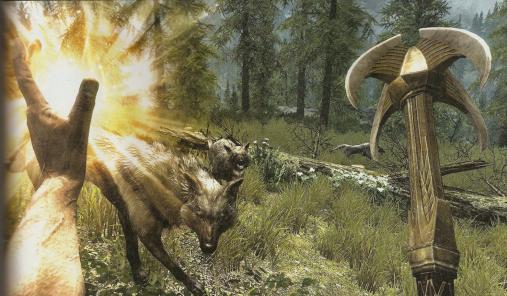
While it does a lot of things right, it’s not without fault. Just like Oblivion, melee combat is still a sore point for Skyrim. The big issue is that the game doesn’t really give you a sense of impact when you hit someone with a sword unless they block it. Otherwise, swings that hit your enemy react the same way as swings that whiff. At a certain point, I just let it go, but the effect can be jarring. Companion AI always seem to block doorways just to annoy you. I really dislike the design decision that limits the amount of money a store has, which means you can rarely ever sell everything you want in one city. From a technical perspective, I did run into one or two scenarios where the game chugged at a single-digit frame rate. When this happened, the game was virtually unplayable.
Skyrim is by no means perfect, though very much deserving of the praise it’s been given. Even with all of the critical acclaim and game of the year awards behind it, I didn’t believe going into it that Elder Scrolls V: Skyrim would grab me at all, let alone grab me as hard as it has. Instead of shrugging it off, I can’t put this game down, as this amazing and wildly addictive RPG to me is a modern day gaming classic. It’s incredible to me how ambitious this game is and how well it executes almost all of its ideas. Though this game may not be enough to ease me into The Lord of the Rings or Dungeons & Dragons, I’ll surely be spending a few more dozen hours immersed in the world of Skyrim.


 In Third Person