
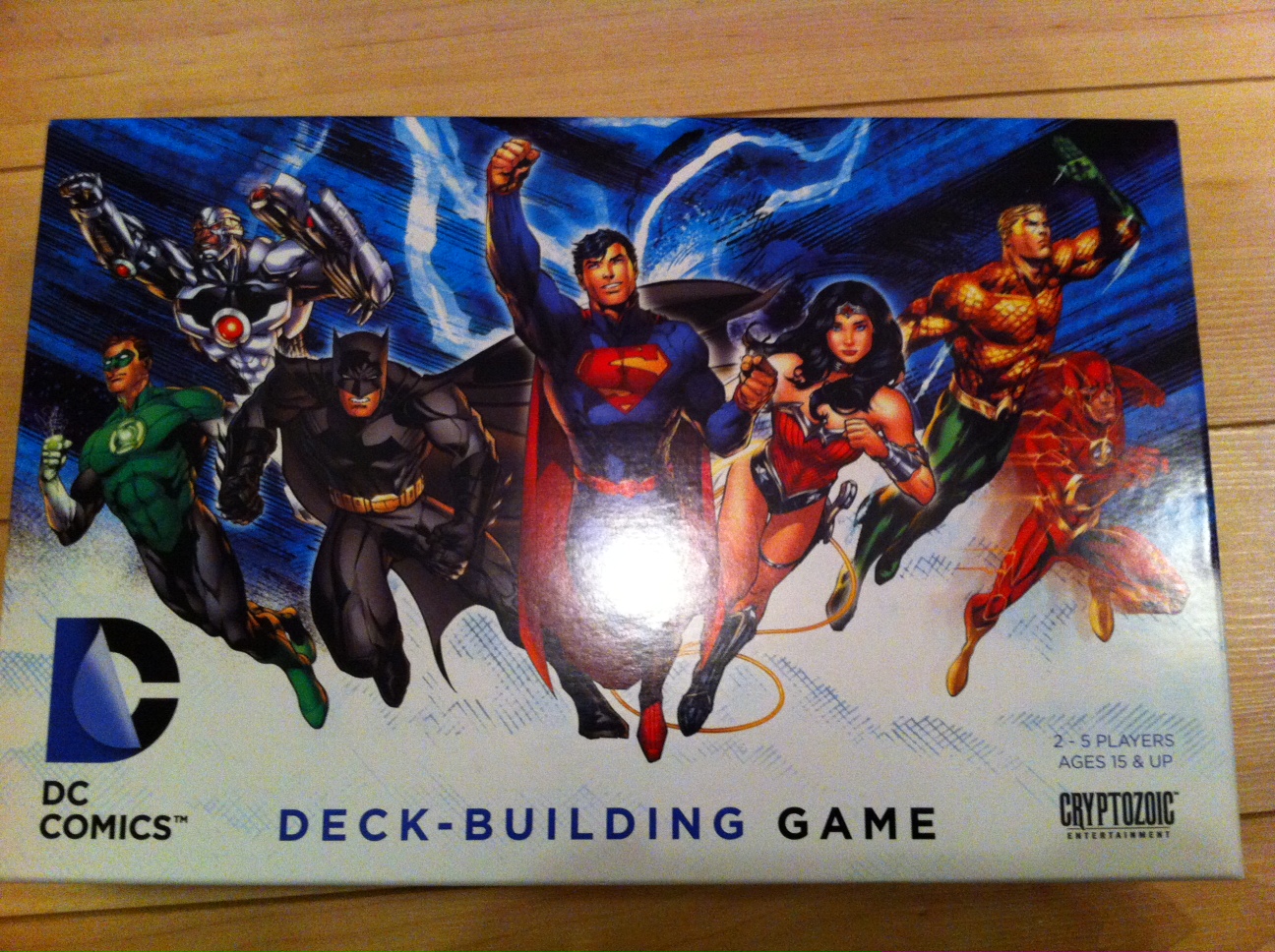
 Steff and I’s entry into the tabletop gaming scene was Dominion. We were quickly captivated by its deck-building mechanics and it’s been the feature game among us and our tabletop gaming night friends ever since. As much as we’ve tried to introduce others to it, the learning curve for it can be steep for players without experience in more advanced tabletop games.
While we were looking to purchase the latest Dominion expansion from the Snakes and Lattes booth at Fan Expo, the knowledgeable staff recommended we try out DC Comics Deck-Building Game. Besides being similar in nature to a game that we adore, they also billed it as being easier to learn. In hopes of using it as a gateway drug to Dominion for our friends while having a great time, we decided to give it a shot.
The underlying premise for DC Comics Deck-Building Game is fairly straightforward. Between two and five players take on the role of superheroes that’s trying to take out all of the supervillains. Once that’s completed, the player with the most victory points is declared the winner.
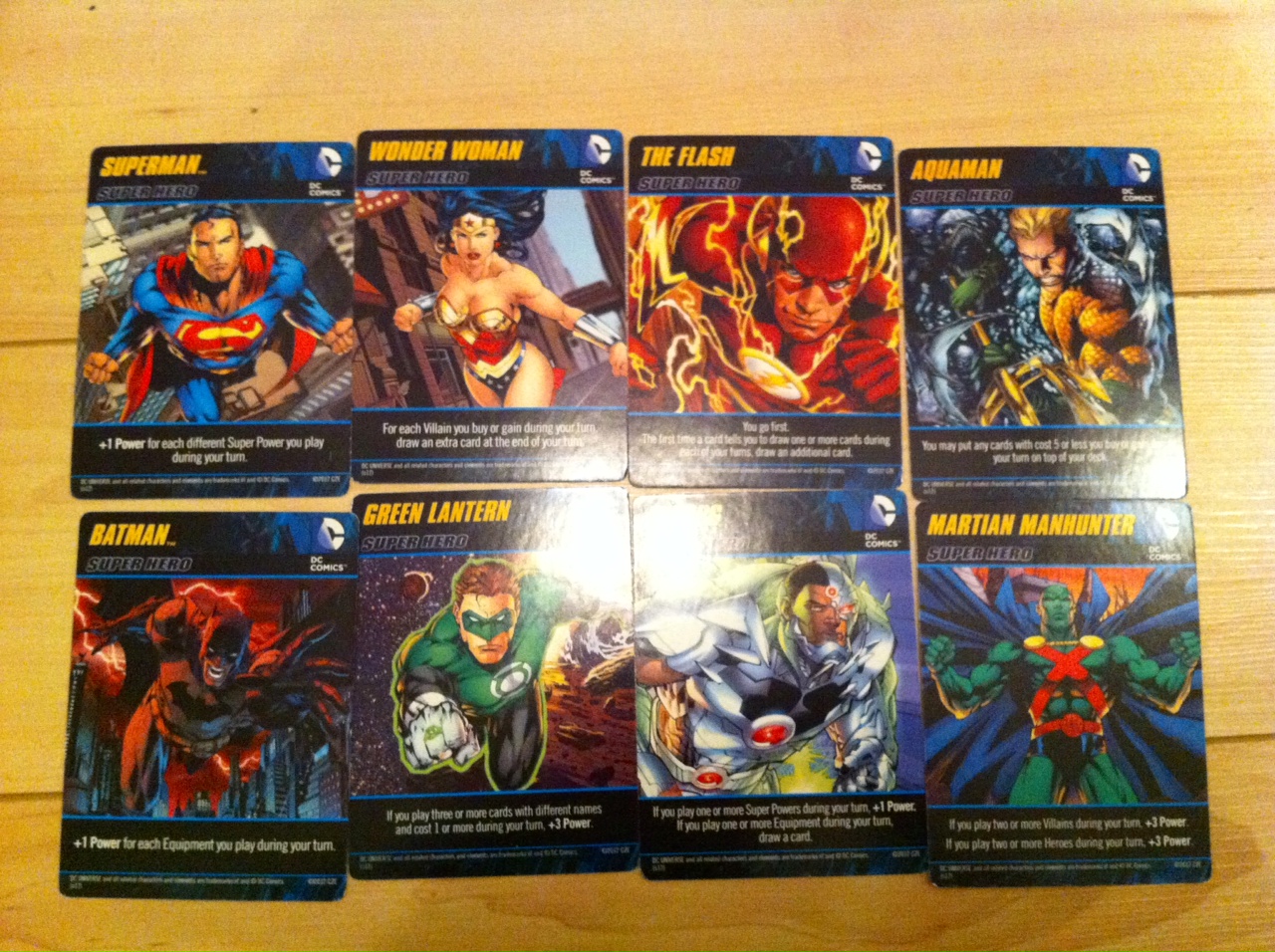 Before the start of the game, each player randomly draws one of seven available superheroes. Luckily for us, we also received the promo-only Martian Manhunter card, which ups our roster to eight. The superhero they draw is their avatar throughout. Each character has a unique ability that is triggered upon certain requirement(s) being met. For instance, Batman gains +1 power each time he plays an equipment card. As such, Batman players may want to skew towards obtaining equipment cards to trigger the power-up more frequently rather than the best overall cards available. These do a great job of making you feel more like your superhero while adding a unique dynamic for each player to consider.
 Once superheroes have been decided on, the game begins. Each player starts out with a handful of punch and vulnerability cards. Punch cards are the equivalent of a base-level currency, while vulnerability cards are useless and just clog your deck. When it’s your turn, use the punch cards to obtain super powers, heroes, villains, equipment and locations to strengthen your hand. By the end of the game, everyone should be able to hit like a truck and drop the supervillains with ease.
The moment-to-moment deck-building action is easier to grasp than something like Dominion while still providing an exciting and engaging experience. It achieves this with a few interesting wrinkles to the deck-building formula that Dominion first set in 2009. For one, players are not limited in the number of actions they can play or the number of cards they can buy during their turn. Also, almost every card serves multiple purposes, as most act as currency, victory points and actions all in one. Those two tweaks in tandem create a dynamic where you simply play what you have and buy what you can afford. With that said, there’s still a lot of thinking that goes into purchasing the right cards and playing them in the right order to optimize your turns.

I do think there was a bit of a missed opportunity to bring a DC Comics-style story to life. Games like Munchkin and Love Letter do a great job of making the story and the gameplay connect cleanly, and I wish this deck-building game could do the same with its rich roster of characters. It’s not necessarily a bad thing since the game is mechanically sound, though I feel like more could have been done to create or engage in a story while you play. The closest thing to a story point is the moment when you take out a supervillain, though that mostly comes off as you throwing down a giant stack of cards to obtain another one.
My other gripes are more superficial in nature. The over-sized superhero cards sit flat in the box, which requires you to either dump them out or wedge your finger in to scoop them out. It would have been better if they stood up like the other cards in the set. Some of the cards could be worded better as well. The Wonder Woman superhero card is supposed to say that you get one extra card in your next hand for each villain you purchase, though it’s worded in a way where that doesn’t come through clearly. Also, the Riddler card could have been clearer in communicating the fact that it’s the Riddler’s ability that can be re-used and not the card you flip over. Once we understood the proper way to use both, this no longer was an issue.
Sporting simpler rules and recognizable characters, DC Comics Deck-Building Game is a great way to jump into the deck-building genre of tabletop gaming. Even for veterans of the sub-genre, there’s no shortage of thrills to be had. There are a few things I wish they’d cleaned up, but they don’t really hinder an otherwise great game. Looking forward to playing a lot more of this one and adding to it with expansions down the road.

 In Third Person