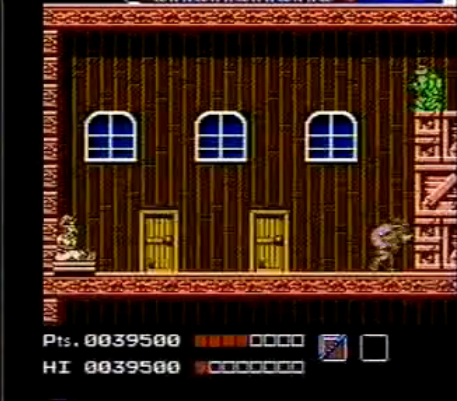
Game Design Talk: The Money Play

The first time I remember finding a “money play” was in the original Teenage Mutant Ninja Turtles game for the Nintendo Entertainment System. After a few fights with Rocksteady, I figured out a cheap way to beat him without him ever touching me. If you’ve ever played this game, you probably figured this trick out, too. If you don’t, the image above shows how to do it. If you’re perched up on those boxes with Donatello and attack down, Rocksteady will just eat your attacks until he dies with no way to fight back. I was only six years old when I figured that out. Before I ever took the time to think about how video games worked, I had already figured out how to exploit the system.

Continue reading

Call of Duty: World at War Pushes Me to the Brink

Call of Duty: World at War was a game that, even after Modern Warfare 2 blew my mind, I had no interest in going back for. It had two major hurdles: it was a World War II shooter and it was made by Treyarch, whom I’ve been lead to believe made the “not-so-good” Call of Duty games.

Well, I decided to give World at War a shot when I saw it on sale at a price I couldn’t refuse. Did it earn a Purple Heart, or make me wish I was killed in action? After finishing the solo campaign, I would say a little from column A, a little from column B.

Continue reading

Game Design Talk: Soul Calibur IV and the Apprentice

Within minutes of first playing Soul Calibur IV, the game has already figured out how to infuriate me. I’m not even close to being a good player at any Soul Calibur game, but I did play enough Soul Calibur II to beat the game on normal difficulty with every character. Having been out of practice, I decided to get reacquainted with the systems by starting out in Arcade mode.

Up until the second last level, I was doing just fine. But it was then that I was pit against the Apprentice.

Continue reading

Game Design Talk: Taking Control Out of My Hands

(SPOILER ALERT: This post will discuss major plot points in Modern Warfare 2 and Prince of Persia)

The terrorist scene in Modern Warfare 2 has been dissected from every conceivable angle by now. Odds are if you’re a fan of reading niche video game blogs like mine, you’ve probably played this sequence and have already come to your own conclusions about it.

For the record, I hate it. I hate it for a number of reasons, but for the sake of this discussion, I’m only going to get into one reason why I dislike this scene. I don’t hate it for the fact that you get to shoot innocent people. I applaud Infinity Ward for leaving that option open. However, that entire scenario is fundamentally broken because of the people you can’t shoot.

Continue reading

Game Design Talk: Burnout Paradise and the Feeling of Progression

For a game that is fairly one-dimensional at its core, Burnout Paradise does a lot of little things to motivate players to keep playing. You will unlock new cars by either winning races or taking them out as they randomly drive by you on the road. The game keeps track of all the super jumps you complete, fences you smash and billboards you drive through. You can even race for the best time on basically every street in the game against your friends or against the world.

Those little things have kept me playing this game longer than I usually plan to. However, each of my sessions usually ends when I realize how far away I am to making progress in the most important measure of progression in the game: the licenses.

Continue reading

Unhappily Ever After

The other night, i could sense that I was close to beating Borderlands. When I get that feeling, I can’t stop and leave that game until I beat it. In spite of the game’s flaws, I was having a ton of fun with the game. However, Borderlands suffers from a problem that has plagued video games since games were designed with a clear progression from beginning to end: a crappy endgame experience. I ended my Borderlands experience with a bad taste in my mouth, feeling like the extra time I could have dedicated to sleep that evening were wasted on a poor endgame experience.

Continue reading